
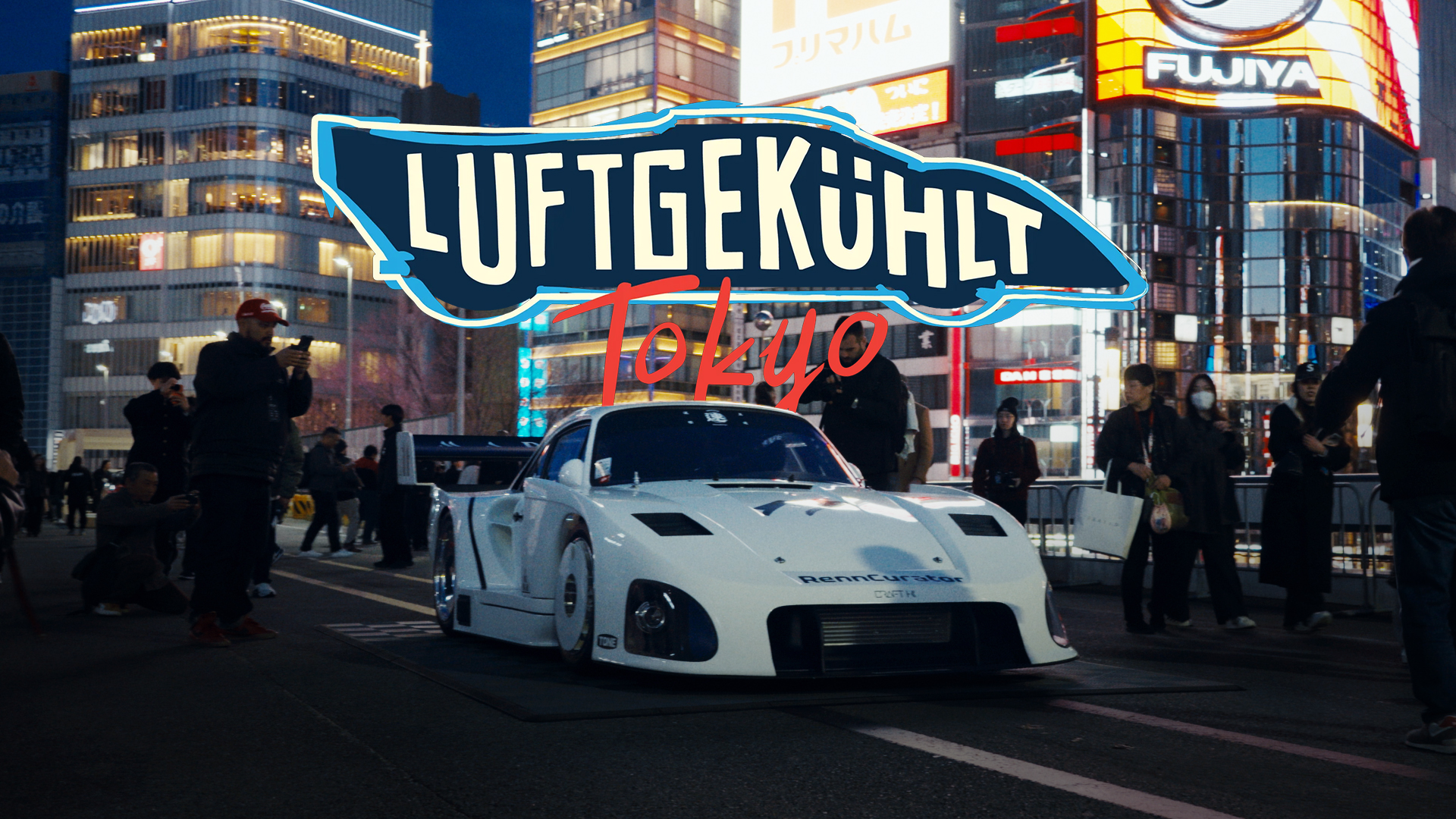
Luft Tokyo: Porsche Takeover of a Highway Above Ginza
For one day, an abandoned stretch of expressway in the middle of Tokyo stopped feeling like infrastructure and became a moving timeline of Porsche history, suspended above the city.
Luft Tokyo transformed the former KK Line into a one-day celebration of Porsche history above the heart of the city.

I knew Luft Tokyo was going to be special. I did not expect it to feel this big.
From the moment I stepped onto the former KK Line, it was clear this was not just another car event. The scale was larger than I had imagined, the atmosphere was more cinematic than I had expected, and the venue itself made everything feel surreal. Being there both during the day and into the evening only amplified that feeling. For a few hours, this elevated roadway above central Tokyo became something entirely different: part museum, part community gathering, part living tribute to Porsche’s history.

What made it even more powerful was the perspective. Until then, this view over the city had mostly belonged to people moving through it behind the glass of a car. At Luft Tokyo, we experienced it in a way that felt almost impossible.

Welcome to Luft Tokyo
A venue that made the event unforgettable
Part of what made Luft Tokyo so special was the location itself.
The event was held on the former KK Line, an elevated expressway in central Tokyo that had long been part of the city’s driving culture. Originally opened in stages beginning in 1959 and completed in 1966, the road was decommissioned in 2025 and is now expected to be repurposed into a public pedestrian space. That alone gave the event an emotional edge. This was not just a stylish backdrop. It was a piece of Tokyo that had already entered a new chapter. We were there right before that transformation.

That is also why Luft Tokyo was something I could never have missed. Luft will likely be the only event of its kind that will ever be held at that very spot. Between the complexity of the location, the cost, and its planned future redevelopment, this may have been one of those rare moments that simply cannot be repeated.
There was also the cultural weight of the road itself. The KK Line has long been associated with Tokyo’s urban car mythology, the kind of place that already carried a cinematic aura before a single Porsche was ever parked on it.

What is Luft?
Luftgekühlt has never been just a car meet.
Created by Patrick Long and Howie Idelson, Luft was built around a simple but powerful idea: present historically significant Porsche road and race cars in unusual and visually striking locations. Since its first edition in California in 2014, the event has grown into one of the most respected names in Porsche culture, not because it tries to be the biggest, but because it is so carefully curated.
That curation is what made Tokyo such a natural fit.

This was the first Luft event held in Tokyo, the first in Asia, and one of the most visually dramatic settings the event has ever used.
220 cars were displayed and approximately 11,600 visitors attended. It also marked the first time a Luft event extended from daylight into the evening, which gave it a completely different rhythm compared with most static car shows.
In Tokyo, Luft did not just bring rare cars together. It brought them into dialogue with the city around them.
Luft did not feel like walking through a car show. It felt like walking through Porsche history above Tokyo.

The scale of the cars was almost overwhelming
What hit me most was not just the rarity of individual cars, but how many historically important models were all gathered in one place.
Even seeing one of some of these cars would already be memorable. Seeing so many together, in one setting, made the event feel almost unreal. Luft Tokyo was an opportunity to walk through decades of Porsche evolution, from early road cars to race legends, and from icons of the air-cooled era to machines that helped define Porsche’s image in Japan.

Among many others, we were graced with:
- Porsche 356 models
- Porsche 911 Carrera RS 2.7
- Porsche 964 N/GT
- Porsche 964 Speedster
- Porsche 964 Turbo
- Porsche 959
- Porsche 904
- Porsche 906 Carrera 6
- Porsche 910
- Porsche 956
- Porsche 962 / 962C
- Porsche 993 RSR
- Porsche 930 Turbo
- Porsche 912 police car
- RUF BTR prototype
- Japan-built customs such as the MADLANE 935ML
Luft was not focused on one narrow version of Porsche culture. It covered factory road cars, homologation specials, race cars, rarities connected to Japan, and even custom interpretations that showed how deeply Porsche has influenced enthusiasts here.


Race cars that carried real historical weight
Some of the most significant machines at Luft Tokyo were the race cars tied directly to Porsche’s competition history in Japan.
Among the most notable was the 1964 Porsche 904, remembered for winning the second Japan Grand Prix. Also documented was the number 28 Porsche 910, driven to victory by Tetsu Ikuzawa and Taki Racing at the 1968 Fuji Grand Prix. And let’s not forget the 1984 TRUST ISEKI Porsche 956.


These were not simply old racing cars parked for display. They carried real historical gravity, having connected the global Porsche story to Japan’s own motorsport heritage.

Road cars, icons, and the impossible density of rarity
The road car side of the event was just as powerful.
There were rows of 356s, multiple RS-era 911s, 964-generation specials, and rarities such as the 959. Something that I noticed way too late and almost missed completely was the grouping of FOUR (of only 20 reportedly made) Porsche 964 N/GT models.

Luft was not simply a matter of seeing rare cars. It was the density of them. The frequency. The way one historically important Porsche would lead directly into another, and then another, until the whole experience started to feel almost dreamlike (not to mention that I turned my head left and right so often that my neck started hurting).
You were not hunting for one special moment. You were at an event filled with special moments.

At Luft Tokyo, even the quieter details carried the weight of decades of Porsche design language.
More than history, it felt like community
What stayed with me most, though, was not only the machinery.
Yes, the cars were extraordinary. Yes, the venue was magical. But what gave the event its real power was the human side of it. Owners, collectors, media, enthusiasts, builders, and visitors had all come together from different parts of the world, and that shared energy was present everywhere.
It felt like a celebration of passion in its purest form.

There was a sense of mutual understanding that ran through the whole event. Whether someone was there to document the cars, study them, admire them, or simply absorb the atmosphere, everyone seemed connected by the same quiet (or not so quiet) appreciation.
That is what made it feel bigger than a car show.
Some events impress you. Others stay with you. Luft Tokyo did both.
A day that is unlikely to happen the same way again
That is ultimately why Luft Tokyo felt so powerful.
It combined a nearly impossible venue, a level of curation that very few events can match, and a gathering of cars that most people would never expect to see together in one place. It gave visitors access not only to remarkable machinery, but also to a version of Tokyo they may never experience again in quite the same way.
For one day, the former KK Line stopped being a forgotten roadway and became a stage for memory, design, engineering, and community.
And that is what made Luft Tokyo unforgettable.

As daylight turned into night, Luft Tokyo became even more surreal. A final reminder that some events are as much about atmosphere as they are about cars.


Leave a Reply