
The Race Weekend I Will Never Forget
When I covered Lamborghini Super Trofeo Asia at Fuji Speedway in Japan in June 2026, I wasn’t expecting to break my leg.
How did I even get there?

It wasn’t my first Lamborghini Super Trofeo, and it wasn’t the first professional race I’d covered. This occasion was different though, because it was the first time I and my team were creating content specifically for one team, our friends at I Auto Rent A Car.
So, effectively, it was the first time my team and I were split between two roles: RPM Generation Media Team, and professional race team media support.
That sounds simple until you’re actually at Fuji Speedway, in the rain, with cars on track, mechanics working in the pits, a team expecting coverage, and a full media schedule running at the same time.


What Lamborghini Super Trofeo Is
Before we continue, let’s talk about Lamborghini Super Trofeo for a moment.
Lamborghini Super Trofeo is Lamborghini Squadra Corse’s one-make racing championship. “One-make” meaning all the cars are based on the same racing platform, so the racing becomes less about who has the biggest technical advantage, and more about drivers, teams, setup, racecraft, consistency, and mistakes.

The Asia series has been part of Lamborghini’s customer racing world since 2012, bringing professional drivers, gentleman drivers, private teams, and Lamborghini dealers to circuits across Asia. In 2026, the Fuji Speedway round was Round 3 of the season, after Sepang in Malaysia and Ningbo in China, and before Inje, Shanghai, Monza, and the World Finals.

The cars are Lamborghini Huracán Super Trofeo EVO2s. That means a naturally aspirated 5.2-liter V10, 620 CV at 8,250 rpm, 570 Nm of torque, rear-wheel drive, a six-speed sequential gearbox, serious aero, slick or wet racing tires, racing ABS, traction control, and enough sound to make you forget about every reasonable life decision you’ve ever made.
In other words, it is not just “a Lamborghini race.” It is probably one of the purest ways to watch Lamborghini racing: same car concept, different teams, different drivers, different classes, and a grid full of V10s trying to survive Fuji Speedway.
Fuji Speedway Made It Better and Harder
Fuji Speedway is one of those circuits that looks simple until you actually have to work there.

On paper, it is famous for the long main straight, Mount Fuji in the background, heavy braking into Turn 1, and a technical final sector that punishes bad rhythm. In reality, for media, it is massive. You don’t just “go shoot a corner.” You plan where to go, when to move, what lens to carry, what access you have, how much time you lose between positions, and what part of the race you are willing to miss to get a different angle.

This matters even more in Super Trofeo because the races are short. The Fuji races were 50 minutes plus the leader, which means you don’t have unlimited chances. If you are in the wrong place, you miss the shot. If you move too late, you miss the shot. If the rain slows you down, you miss the shot.
And if you are covering both general media and a specific team, you are basically doing two jobs at once.
Always be double ready, double shooting, double planning, and double timing.

Double the Work, Double the Reward
When I was presented with the opportunity to get a closer look at a specific team, I jumped at the occasion.
At the same time, I would have participated regardless as RPM Generation Media. What that implied though, was double the work and switching from one style to another in real time.
For RPM Generation, I needed the full event story: cars on track, atmosphere, rain, pits, details, emotion, Fuji Speedway, and the overall championship feeling.

For the team side, I needed something more specific: the people, the car, the preparation, the mechanics, the drivers, the tension, the small moments, and the kind of content that actually matters to a team after the weekend is over.

Those are not the same shots. They are not the same timing. They are not the same mental mode.
Here is where my story starts, but if you want to jump directly to the good stuff, take a look at the collection of videos and photos at the end of the article or here.
Rain Is Beautiful Until You Have to Work In It

We were expecting bad weather.
Of the three days I was there, Friday was the only one with merciful weather. The rest was pouring rain.
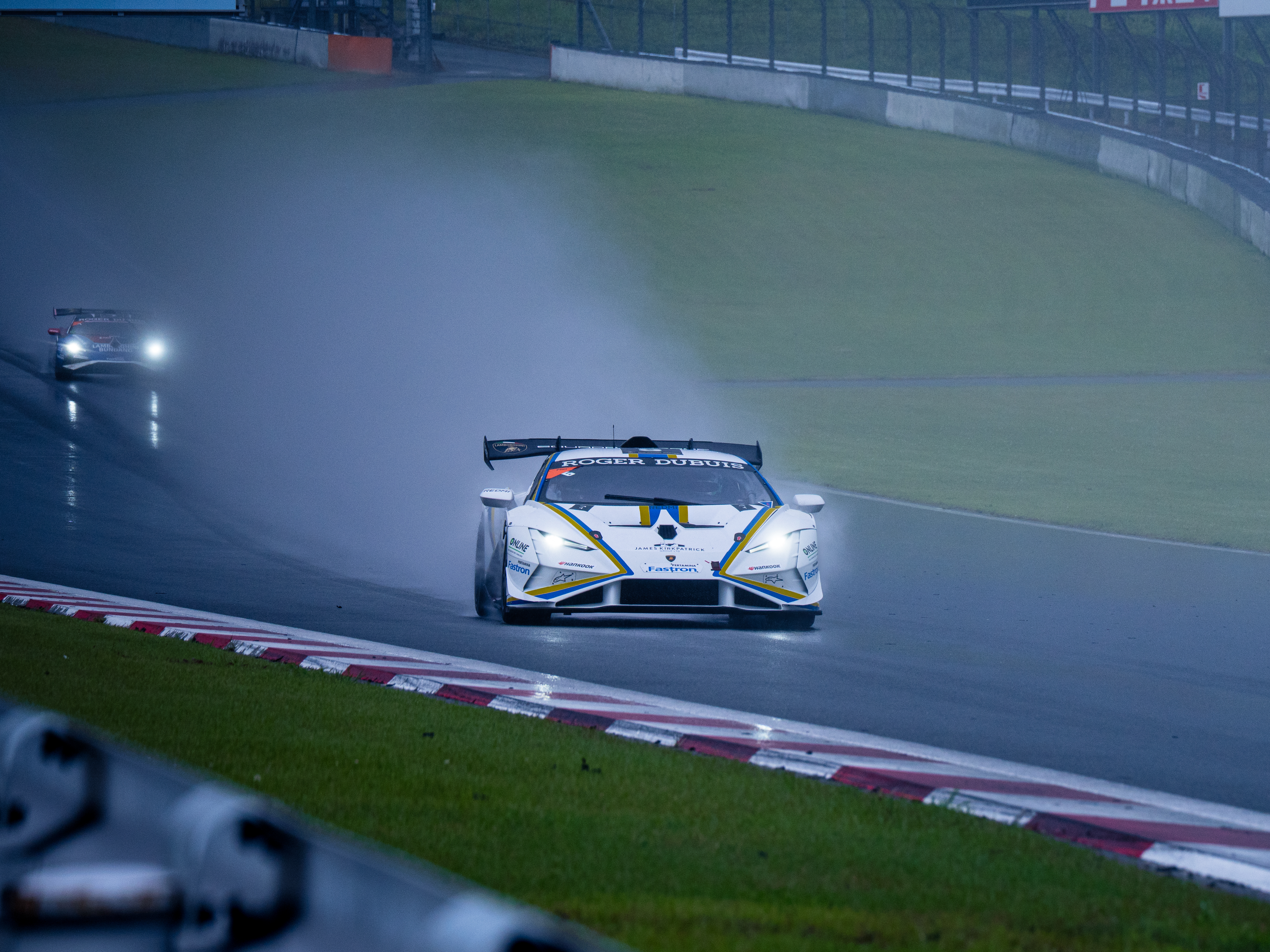
Don’t get me wrong, to a certain extent rain on track is a photographer and videographer’s blessing. The end result is cool and gritty, dynamic and emotional. Wet asphalt reflects light. Spray makes the cars look faster. Brake lights glow harder. Mechanics look more dramatic. Drivers look more heroic. Everything suddenly has more story.

While shooting though, especially carrying thousands of dollars of equipment, rain can be challenging.
Camera covers help, but they also make it harder to operate buttons, harder to check the screen, harder to change settings, and harder to react quickly. Lenses fog. Bags get heavy. Your clothes get soaked. Your shoes lose grip. Every move becomes slower.
This will matter later, when I broke my leg.
Hold onto it.

Friday: Calm Before the Storm
The first day was pretty chill.
We shot b-roll, in-pit images, details, preparation, and the kind of quiet content that usually becomes more valuable after the race weekend is over. Mechanics working. Cars being checked. Drivers moving through the paddock. People preparing before the chaos starts.

We covered the qualifying sessions, planned the schedule for the following days, and decided what corners to shoot and when. I also met a bunch of fellow photographers.
It was a good start.

At Fuji, Lamborghini Super Trofeo always looks right. The cars fit the place. The long straight gives them room to breathe, the tight sections make them look aggressive, and when Mount Fuji appears in the background, the whole scene becomes almost too perfect.
Of course, the mountain mostly stayed hidden behind rain and clouds, because Fuji Speedway likes to remind you that nothing is guaranteed.
Saturday: The Race Weekend Gets Real
The following day, as expected, bad weather caught up with us, but we were ready.
Cameras were covered. Bags were packed. Batteries were charged. I ran around the track and drove to a bunch of strategic spots to get the best angles.
And honestly, I got everything I wanted and more.

The rain made the cars look violent. The spray coming off the Huracáns gave every shot more movement. Fuji’s long straight became a tunnel of water. The braking zones looked tense. The pit lane felt alive.

Race 1 was properly wet. William Tregurtha and Jonathan Cecotto took the overall and PRO win for Batmobile Racing in car #3, finishing 24 laps in 50:13.759. Behind them, Todd Kingsford and Chris van der Drift took the PRO-AM win for VSR in car #98, while Zhicong Li and Titus Sherlock finished second in PRO for Lamborghini Bundang by Racegraph. The AM class was won by Suttiluck Buncharoen for True Visions Motorsports Thailand, and Lamborghini Cup went to Supachai Weeraborwornpong for Siamgas Corse.
The only thing missing for me was shots of the team I was covering on the podium.
They did get the podium, but no problem, I thought. Surely I’ll catch the podium tomorrow for the second race.

So I went on and took more mood shots, in-pit mechanics, engineers, image girls, team moments, details, and anything that could help tell the full story.
By the end of the day I was exhausted, but I still needed to edit.
Back at the hotel, I spent a few hours editing, backed up the files, checked what we had, planned what was missing, and went to bed ready for the last day.

Sunday: The Fall
I woke up early, packed my stuff, and while mildly exhausted, I was ready for the last day.
I set my base in the pits, directed my team, and made my way to the first shooting spot.
Here we can speculate for ages why it happened, and probably being tired was a factor, but the actual situation was simple.
I was walking downhill, in the rain, on a hill covered in mud and wet grass, with sneakers, carrying camera gear.
I lost my footing and started sliding down while holding my camera and lens. In an attempt to protect my camera from what I realized was an inevitable fall, I shifted my weight and slid again.
This time my right leg crossed under my full falling weight and I heard a distinctive, clear snap.
Like a huge pencil breaking.
A sharp pain shot to my head and I knew as a fact I had broken my leg. I just wasn’t sure what bone.
The story of the broken leg and the subsequent rescue is for another day.
But yes, I broke my leg at Lamborghini Super Trofeo.
And yes, somehow, I still loved the weekend.
The Race Continued Without Me
While I was dealing with the kind of problem you definitely don’t put on a shot list, the race weekend continued.

Race 2 was also rain, also wet, and much more interrupted. The official classification shows a safety car at the start, a red flag, and another safety car before the race continued. That explains the much longer total race time and the lower average speeds compared with Race 1.
Once again, car #3 of Batmobile Racing won overall and PRO, with William Tregurtha and Jonathan Cecotto finishing 23 laps in 1:36:19.944. Zhicong Li and Titus Sherlock finished second overall and second in PRO for Lamborghini Bundang by Racegraph, with Liam Sceats and Gustaw Wisniewski third overall for VSR.
In PRO-AM, Todd Kingsford and Chris van der Drift took another class win for VSR. AM went again to Suttiluck Buncharoen, and Lamborghini Cup went again to Supachai Weeraborwornpong.
So, even from the results alone, Fuji Round 3 had a clear story: Batmobile Racing controlled the overall, VSR stayed strong in PRO-AM, and the wet conditions turned the weekend into a test of patience, control, and survival.

Why It Was Still Worth It
Here is why, despite the broken leg, I loved covering Lamborghini Super Trofeo at Fuji Speedway.
Races like Super Trofeo are where you are tested as a professional photographer, just like drivers are tested on track.
You have to plan, move fast, catch the right timing, and you don’t have many chances to do so. You have to understand the rhythm of the race, the rhythm of the team, the rhythm of the track, and the rhythm of your own work.

Track race photography is challenging and fulfilling, and not as easily accessible as a lot of other automotive content. This is where pride also steps in.
Being selected as media to cover these races, while also being trusted by a team to cover their side of the story, is something that makes me function at 200% capacity.
Arguably very stressful and tiring, but also so fulfilling that you don’t even feel it until after the fact.
Or until your leg snaps.

What I Took Away From Fuji
That Lamborghini Super Trofeo Asia weekend at Fuji Speedway, in the rain and with a broken leg, will remain one of my fondest content creation memories.
Not because of the injury. Obviously.
But because it had everything I love about automotive media: racing, pressure, access, teamwork, weather, noise, emotion, and a real story.
The rain made the photos better. The team access made the coverage more personal. The race gave us drama. Fuji gave us the setting. Lamborghini gave us the sound.
And my leg gave me a very painful reminder that sometimes the story behind the shot becomes part of the shot itself.
But what do YOU think of my photos and the RPM Generation team’s videos?


Leave a Reply