
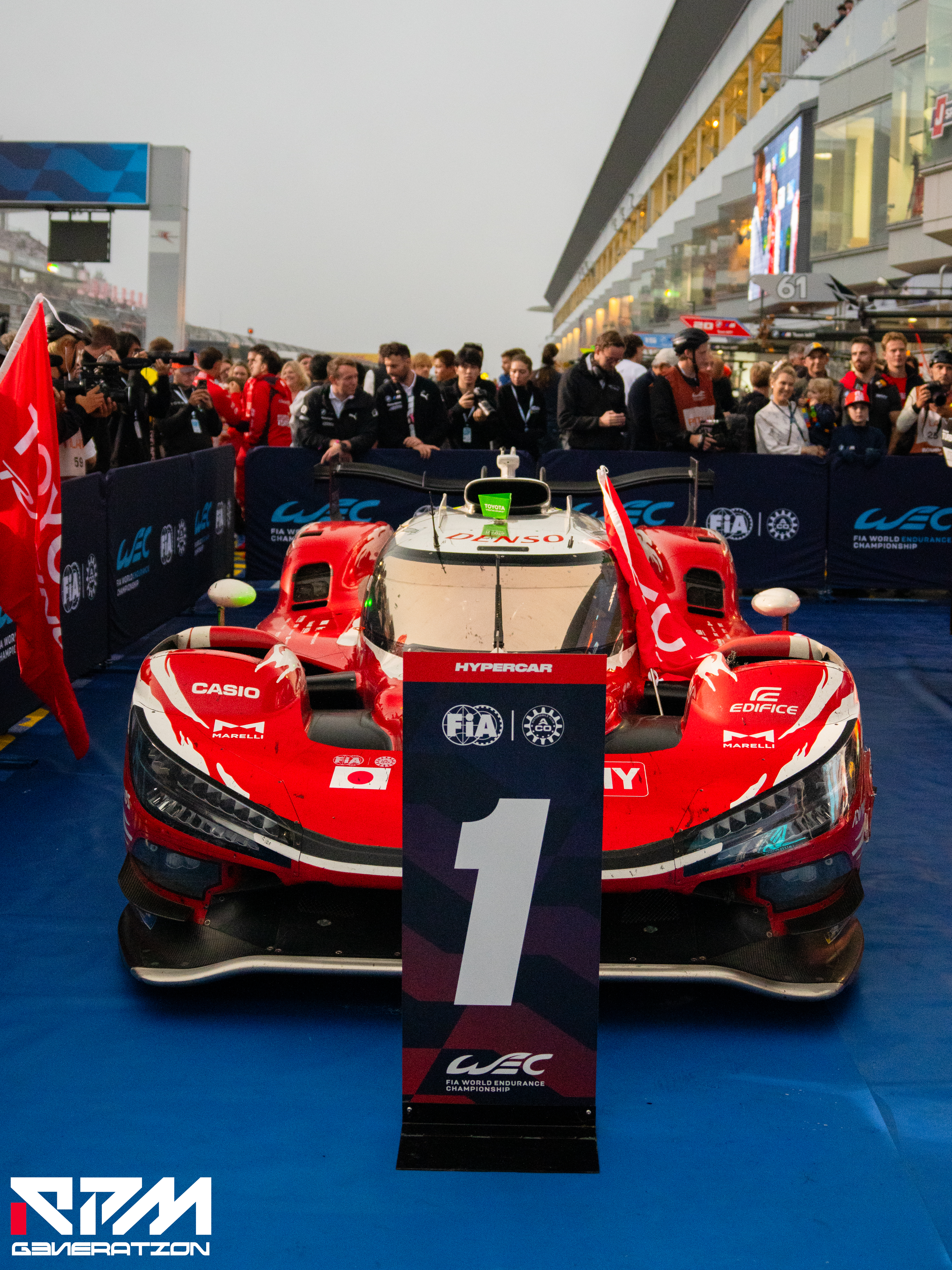

Toyota Racing stole a dramatic home victory from Alpine in the closing minutes of the 2026 FIA WEC 6 Hours of Fuji, but from behind the camera, the weekend was about much more than the final result. Rain, cancelled qualifying, garage access, crashes, strategy and one frantic final sprint made my first WEC event one to remember.
Friday at Fuji Speedway was almost deceptive. The opening day of the 2026 FIA World Endurance Championship’s 6 Hours of Fuji took place in dry conditions. Toyota was immediately quick at home, with Ryō Hirakawa putting the #8 Toyota TR010 Hybrid at the top of FP1, before Victor Martins moved the #36 Alpine A424 to the top of FP2 with a 1:29.304. Alpine, Aston Martin and newcomer Genesis Magma Racing all showed genuine pace before the weather changed the character of the weekend completely.
I wasn’t shooting on Friday. That meant that the first time I would properly experience the WEC cars trackside was under very different circumstances.
Saturday: Fuji changes completely

Saturday morning arrived wet. Not the kind of rain where you throw a cover over the camera and essentially continue as normal. Fuji had become grey, soaked and increasingly unpredictable.
Before going trackside, I spent part of the day inside the garages, particularly with Aston Martin and Genesis Magma Racing.

Aston Martin gave me the opportunity to spend time around both sides of its WEC operation, from the Vantage LMGT3 to the extraordinary V12-powered Valkyrie Hypercar. Genesis Magma Racing were also extremely welcoming and hospitable, allowing me to experience their operation around the GMR-001 from much closer than the average paddock visit.


Media accreditation gets you into areas of the circuit that spectators cannot normally access, but it does not automatically mean that you can simply walk into a team’s working garage. You are entering their workplace during a World Championship event, and ultimately it is the team that decides whether you are welcome there.

FP3 went ahead in full wet conditions, and Victor Martins again put the #36 Alpine fastest with a 1:40.594. The difference from Friday was enormous. His wet-weather benchmark was more than eleven seconds slower than his FP2 time.
The Aston Martin Valkyries followed in second and third, ahead of the #94 Peugeot and #19 Genesis. But the session was not clean. The #007 Aston Martin Valkyrie and #27 Heart of Racing Vantage LMGT3 collided, bringing out a red flag and ultimately earning the #007 a grid penalty.

For photography, however, the conditions could have been spectacular. The spray, headlights, reflections and reduced visibility transform cars visually. So I found the position I wanted, decided on the photograph I was looking for and stood in the rain for roughly 25 minutes waiting for it.
That is one of the things a finished photograph never really tells you. You see the frame. You don’t see the waiting. You don’t see the wet equipment, the rain cover, constantly checking the camera and wondering whether the car will actually take the line you need when it finally appears.
And then qualifying started… and stopped almost immediately.
Conditions had deteriorated so badly that only 1 minute and 44 seconds of LMGT3 qualifying were completed before the session was red-flagged. With standing water and visibility becoming too dangerous, the remainder of qualifying and Hyperpole for both classes was cancelled. The grid would instead be determined by the fastest laps recorded across the three practice sessions.
That handed Alpine a front-row lockout. The #36 would start from pole alongside the #35.
The #007 Aston Martin’s two-place penalty for its FP3 accident promoted Genesis Magma Racing’s #19 GMR-001 to third, while the #17 Genesis would start fifth.

For a manufacturer competing in its first WEC season, it was a significant moment. Shortly after the decision, Genesis Magma Racing’s James Broomhead went on record:
“This will be the best starting positions yet for the team.”
Friday had shown us who was fast. Saturday showed us how quickly Fuji could make that information irrelevant.
Sunday: Six hours to settle it

Sunday was more merciful. The weather remained changeable, but compared with Saturday, the circuit finally gave photographers and teams some breathing room. Rain would return at around 16:30, but never with anything approaching the intensity that had effectively wiped out qualifying the previous afternoon.
And for the first time that weekend, I could properly experience what covering an FIA WEC race actually meant.
This was my first WEC event as an accredited photographer, and one of the things that surprised me most was the organization.

Fuji is a large circuit. During a six-hour race, a photographer constantly has to decide where to go next. A position that produces the photograph you want at one moment might be useless for what you need 30 minutes later.
Moving everywhere on foot would consume an enormous portion of the race.
Instead, the photographer and media shuttles circulated around the circuit constantly.
They were frequent enough that I could shoot from one part of Fuji, move to another section, work there and then move again without feeling that half the race was disappearing while I travelled.
At one point, the system even gave me enough time to stop and edit.
It sounds like a small thing when Hypercars are fighting for a World Championship around you, but from the media side it completely changes how you can work.

And while I was learning how to cover WEC, the race itself wasted absolutely no time becoming chaotic.
First-lap chaos
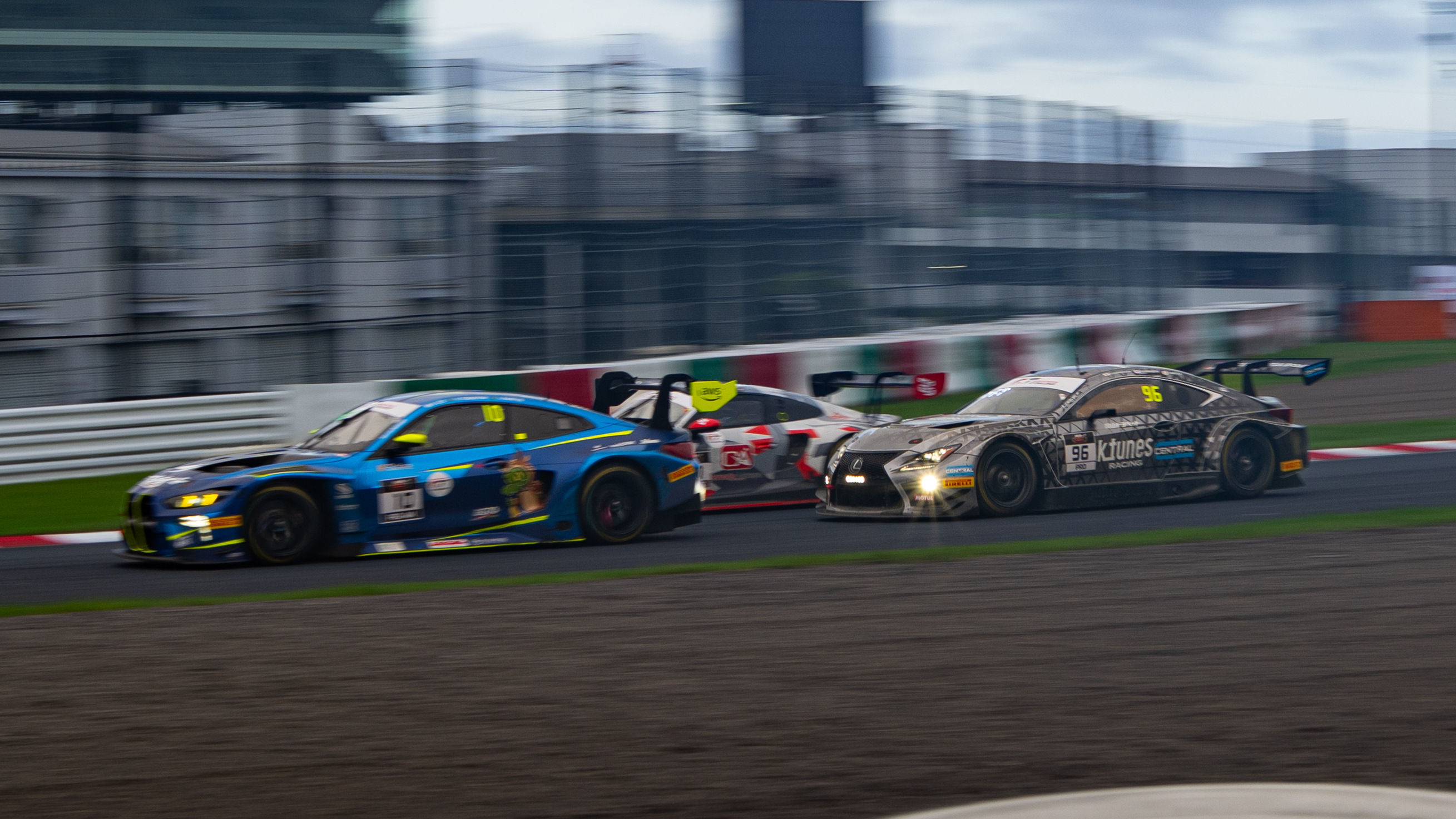
Turn 1 produced immediate trouble in LMGT3.
Several cars became involved in a multi-car accident. Race Control ultimately penalised Tom Van Rompuy in the #78 Akkodis ASP Lexus for triggering the collision after out-braking himself into the corner.

The #88 Proton Competition Ford Mustang and #61 Iron Lynx Mercedes-AMG were both forced to retire from the resulting damage, while the #92 The Bend Manthey Porsche required repairs and fell to the rear of the field.

Toyota’s #7 suffered a slow left-front puncture early in the race, forcing Nyck de Vries onto an offset strategy. That actually brought the Toyota back into the lead fight, but an attempted move on Ferdinand Habsburg in the #35 Alpine ended in contact and a spin for de Vries.
Soon afterwards, the #23 Heart of Racing Aston Martin Vantage was involved in contact with the #94 Peugeot and went off circuit, prompting another neutralisation. Peugeot was subsequently penalised for the incident.

The #93 Peugeot later became the first Hypercar retirement after Paul di Resta encountered a gearbox problem.
Ferrari and BMW had troubles of their own. The title-contending #20 BMW suffered a puncture and rear-end damage following contact with the #51 Ferrari through traffic, while the #50 Ferrari that had won the previous round at COTA would eventually retire with a loss of power.
Through much of the disorder, Alpine looked remarkably composed. The #35 and #36 A424s controlled large portions of the race. Aston Martin, however, was refusing to disappear.


Aston Martin joins the fight
The #007 Valkyrie of Harry Tincknell and Tom Gamble became a genuine threat to Alpine and briefly took the overall lead during the fourth hour.
Then came a costly mistake.
Gamble crossed the white line at pit entry and received a drive-through penalty, dropping the #007 from the lead to seventh and handing control back to Alpine. The Valkyrie would later receive another penalty after contact with the #8 Toyota and eventually finish 14th.
For several hours, however, the possibility of an Aston Martin victory had been very real.
The #009 Valkyrie was also inside the fight before dropping back late in the race, eventually being classified tenth in the provisional results.
Genesis Magma Racing spent significant portions of the race inside the top six as well. The #19 GMR-001, which had started third after Saturday’s grid reshuffle, was running sixth at the four-hour mark in what FIA WEC described as the manufacturer’s strongest showing of its rookie campaign to that point.

Ultimately, the #19 finished 11th and the #17 15th.
But the race still had one major twist left.
One crash changes everything
In the final hour, Finn Gehrsitz in the #58 Garage 59 McLaren and Mattia Drudi in the #27 Heart of Racing Aston Martin were involved in an accident.

The resulting neutralisation sent the Hypercar leaders into the pits for what would become their final stops. Toyota saw an opportunity. #8 had started only eighth and had not controlled the race. Alpine had.
But Toyota calculated that it could take only the fuel necessary to reach the finish and, crucially, chose not to change tyres. That shorter stop put Ryō Hirakawa into the lead.

The official FIA WEC report confirmed that the #8 Toyota emerged with the vital track position and that racing resumed with only 21 minutes remaining.
Suddenly, six hours of racing had effectively become a sprint. Behind Hirakawa, Victor Martins began coming fast.
The #36 Alpine had fallen behind during the stops but had fresher left-side tyres. Martins worked his way back through the cars ahead, including the sister #35 Alpine and the #15 BMW.
With less than ten minutes remaining, he cleared Dries Vanthoor’s BMW. Only Toyota remained.
Running to the pits


By this point, our job as photographers changed again. We knew where the story was likely to happen.
With Hirakawa leading his home race and Toyota having executed the strategic move that could win it, we headed towards the Toyota garage hoping to photograph the reaction from inside as the #8 came to the flag.
We couldn’t get in. Media access was not being allowed into the Toyota pit.
Alpine was directly behind Toyota, Martins was closing, and there was still a very real possibility that the #36 could steal the race in the final minutes.
If Toyota wasn’t an option, Alpine absolutely was. And suddenly I found myself inside the Alpine garage watching the final laps of the 6 Hours of Fuji with the team that was trying desperately to catch the leader.

It was one of those situations where watching timing screens somehow becomes as intense as watching the cars themselves.
The gap moved. Martins pushed. Hirakawa defended. The rain had also started to return, adding another variable at exactly the wrong, or perhaps perfect, moment. Toyota’s advantage was tiny.
For a few moments, it genuinely looked like Alpine might get there.
After six hours and 203 officially classified laps, the winning margin was 0.591 seconds.

Hirakawa crossed the line in the #8 Toyota TR010 Hybrid to give Sébastien Buemi and Brendon Hartley the victory alongside him, Toyota’s tenth FIA WEC win at Fuji and its first at the circuit since 2023.
The crew also became the first in the 2026 season to win two races. Hirakawa described the finish simply:
“It was amazing. I would just describe it as joy.”
He also acknowledged just how stressful those final laps had been as Martins filled his mirrors. Toyota won the gold.
Alpine had led most of the race and had fought back after the final strategy shuffle.


And they had finished less than six-tenths of a second away from victory.
That is endurance racing.
2026 WEC 6 Hours of Fuji results
At the time of writing, FIA WEC lists the race classification as provisional.
The #8 Toyota of Sébastien Buemi, Brendon Hartley and Ryō Hirakawa won overall.
The #36 Alpine of Jules Gounon and Victor Martins finished second, just 0.591 seconds behind.
The #15 BMW M Hybrid V8 of Kevin Magnussen, Raffaele Marciello and Dries Vanthoor completed the Hypercar podium, 6.415 seconds behind the winner.
The sister #35 Alpine of Charles Milesi and Ferdinand Habsburg finished fourth, followed by the #38 Cadillac Hertz Team JOTA entry in fifth. Peugeot’s #94 was sixth, the #12 Cadillac seventh, Toyota #7 eighth, Ferrari #51 ninth and the #009 Aston Martin Valkyrie completed the top ten.
In LMGT3, the #32 Team WRT BMW M4 LMGT3 Evo of Darren Leung, Sean Gelael and Augusto Farfus won the class after Farfus made the decisive move during the final 12 minutes.
My first WEC weekend
For my first WEC event, I don’t think I could really have asked for much more.
And once the chequered flag fell, I was finally finished working., which meant, naturally, that it was time to start working.
Back to the media centre.
Cards out of the cameras.
Photos to select.
Photos to edit.
Footage to organise.
And an article about six hours of racing that somehow needed to explain why the final twenty minutes felt like they lasted another six.
Leave a Reply